Desert soils are downright unusual! They vary tremendously in texture; many are sandy and gravelly, while others contain layers of sticky clay, or even rock-hard, white limy layers. Desert soils may be gray-colored, brown, or even brick red. In the more arid parts of the Sonoran Desert, surfaces of some soils are covered by a layer of small stones that can be as tightly interlocked as pieces of an ancient Roman mosaic, and are coated with dark, shiny rock varnish. Many of these diverse features of desert soils have taken thousands of years or more to form. Characteristics of these soils also greatly affect, and are greatly affected by, desert organisms.
In a dynamic equilibrium, the rate of loss is equal to the rate of gain.
Primary succession starts on bare surfacesand is typically a slow process. Secondary succession starts in an area which had been previously inhabited and is comparatively faster than primary succession.
Succession in the Desert:
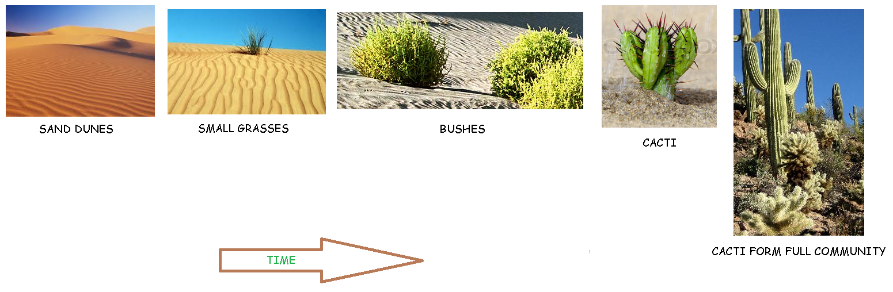
Sand dune formation ----> small grasses colonize in sparce spots ----> more grasses and possibly some other plants as sand dune stabilizes----> bushes colonize ----> a few cacti colonize ----> cacti increase in number and type ----> cacti form full community with variety of types and age classes
