All animals, including humans, absord oxygen(O2) and exhale carbon (CO2). Plants take in carbon and exhale oxygen. In this way, plants and humans have a system of mutual benefit and dependence on eachother. When a plants breathes in CO2 and gives off O2, the plant takes the carbon atom and converts it into plant matter through photosynthesis, storing the carbon in the plant. When the plant dies and decays, the carbon is eaten by bacteria or insects and is released back into the atmosphere as CO2 (carbon).
The carbon cycle in the desert is a non-stop and continuous process. It involves the desert plants absorbing carbon dioxide, sunlight, and water in the process called photosynthesis to make food and carbon rich compounds. When plants wither and die, they undergo decomposition releasing the carbon elements into the soil as nutrients which are then absorbed by other sprouting plants. Desert animals also partake of these plants, breathe out carbon dioxide and decompose upon death and the cycle continues. This cycle is important to the animals living in the desert because it moves carbon, a life sustaining element, from the atmosphere to the organisms living in the desert and back into the atmospere again. | 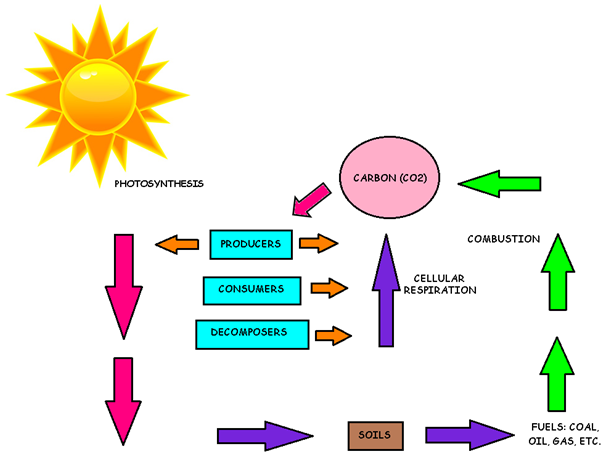 |
Matter does not flow through an ecosystem the same way that energy flows through an ecosystem. There is not an unlimited supply of energy. Plants have to keep producing it in order for energy not to run out. As energy moves through a food chain, the amount of energy available decreases. Matter flows through an ecosystem as a cycle. It is a continuous process that never ends. Therefore there will always be matter in an ecosystem.
